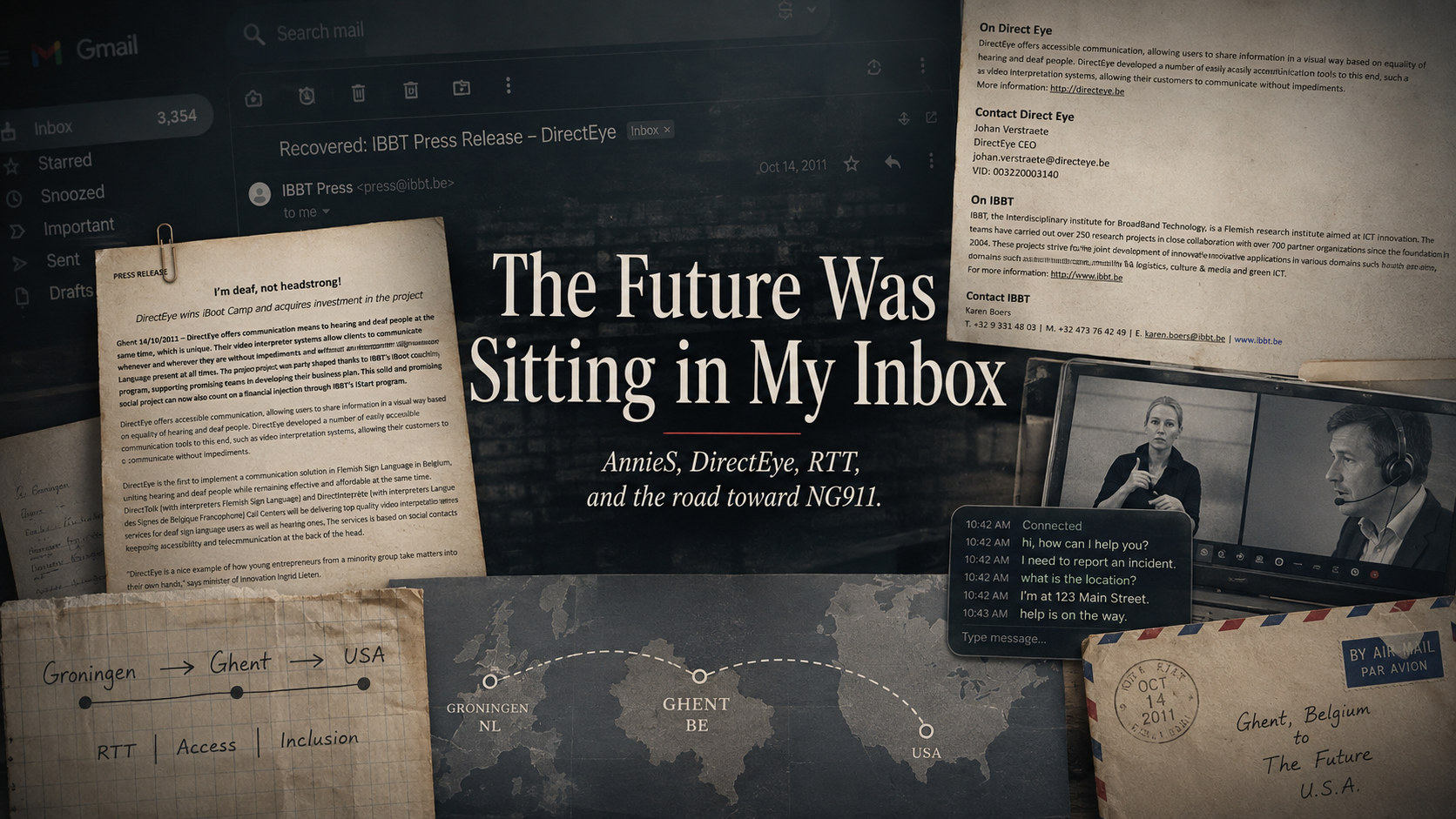
I had almost forgotten
A few days ago I started thinking about Groningen again.
I remembered the BlackBerrys. I remembered the Dutch office. I remembered learning Nederlandse Gebarentaal, train rides across the Netherlands, and long conversations about Total Conversation and real-time text. I remembered AnnieS as the place where a young American got to see another country's accessibility system from the inside.
That memory was incomplete.
I searched my Gmail archive expecting scraps — a dead website, an old brochure, perhaps a conference program. Instead I found weekly reports, strategy documents, product art, photographs, project discussions, business plans, and correspondence stretching across several years.
The first document changed the whole story.
The assignment was America
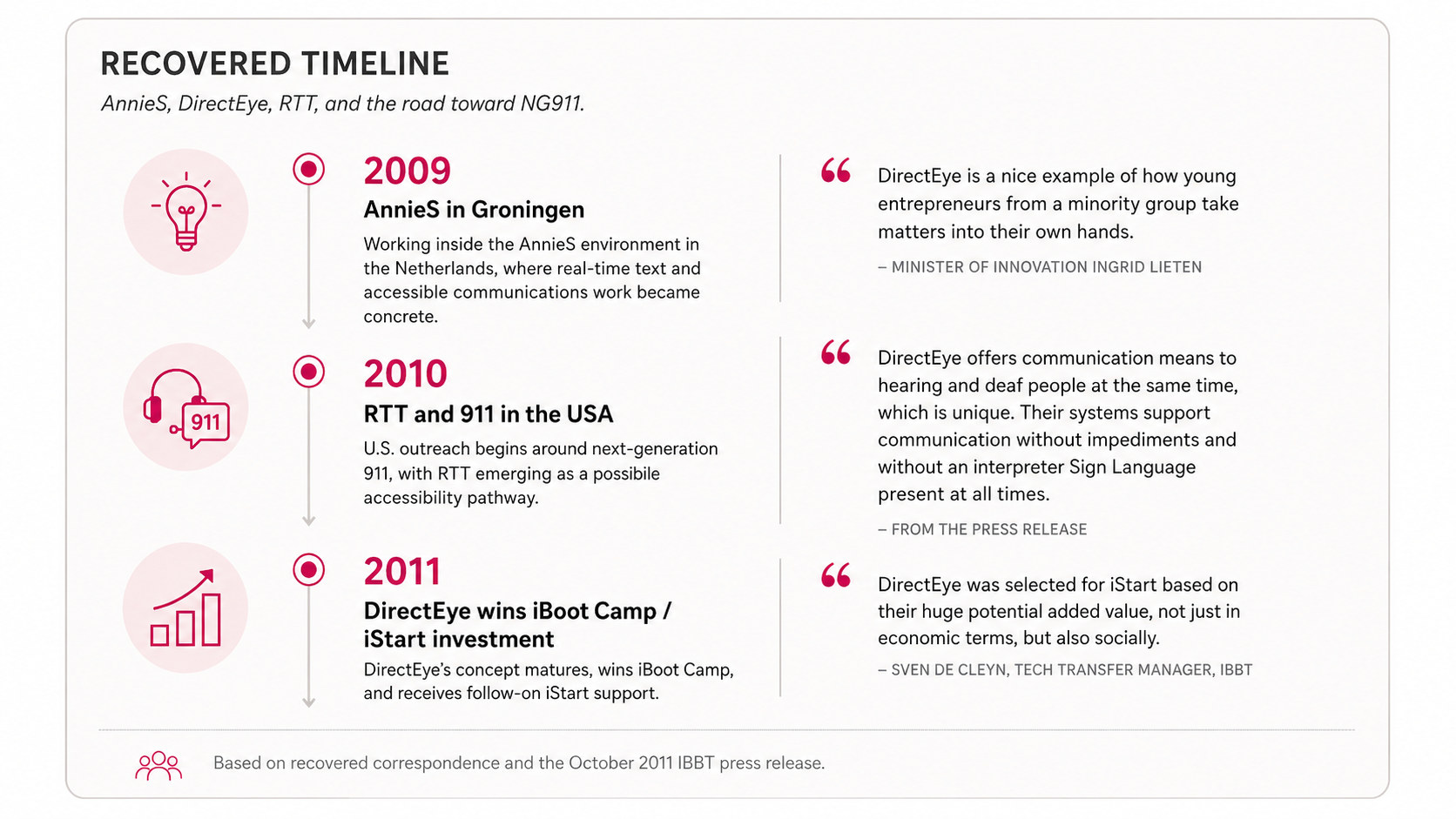
On June 15, 2009, I arrived in Groningen from Amsterdam at about ten in the morning. Raymond Kruyer picked me up from my hotel at noon and took me to AnnieS for my first day. My weekly internship report records what happened next.
Raymond, Frans and I spent most of that first day discussing what I would actually do. I wrote that most of my work would focus on expanding RTT in the United States, along with adding new services to the AnnieS portfolio.
I had remembered the transatlantic piece as something that emerged later. It did not. It was there on day one.
“Viable or no Viable... It doesn't matter. The Golden Age of Deaf Telephony still awaits us all. We are the future. The future is NOW.”
I was not only in Groningen that year. I also spent time in Ghent, Belgium, moving physically between the Dutch and Belgian sides of the accessible-communications world I was beginning to understand. The later DirectEye company had not yet taken the shape it would have by 2011, and I do not want to backdate that story. But Ghent was already part of my 2009 map. My surviving Twitter archive memorializes those Belgian sojourns more clearly than my later memory did.
“Google Latitude must have had a ball with my location info on Friday. Ghent to Groningen -via Antwerp, Zandvoort and Amsterdam- all in 1 day”
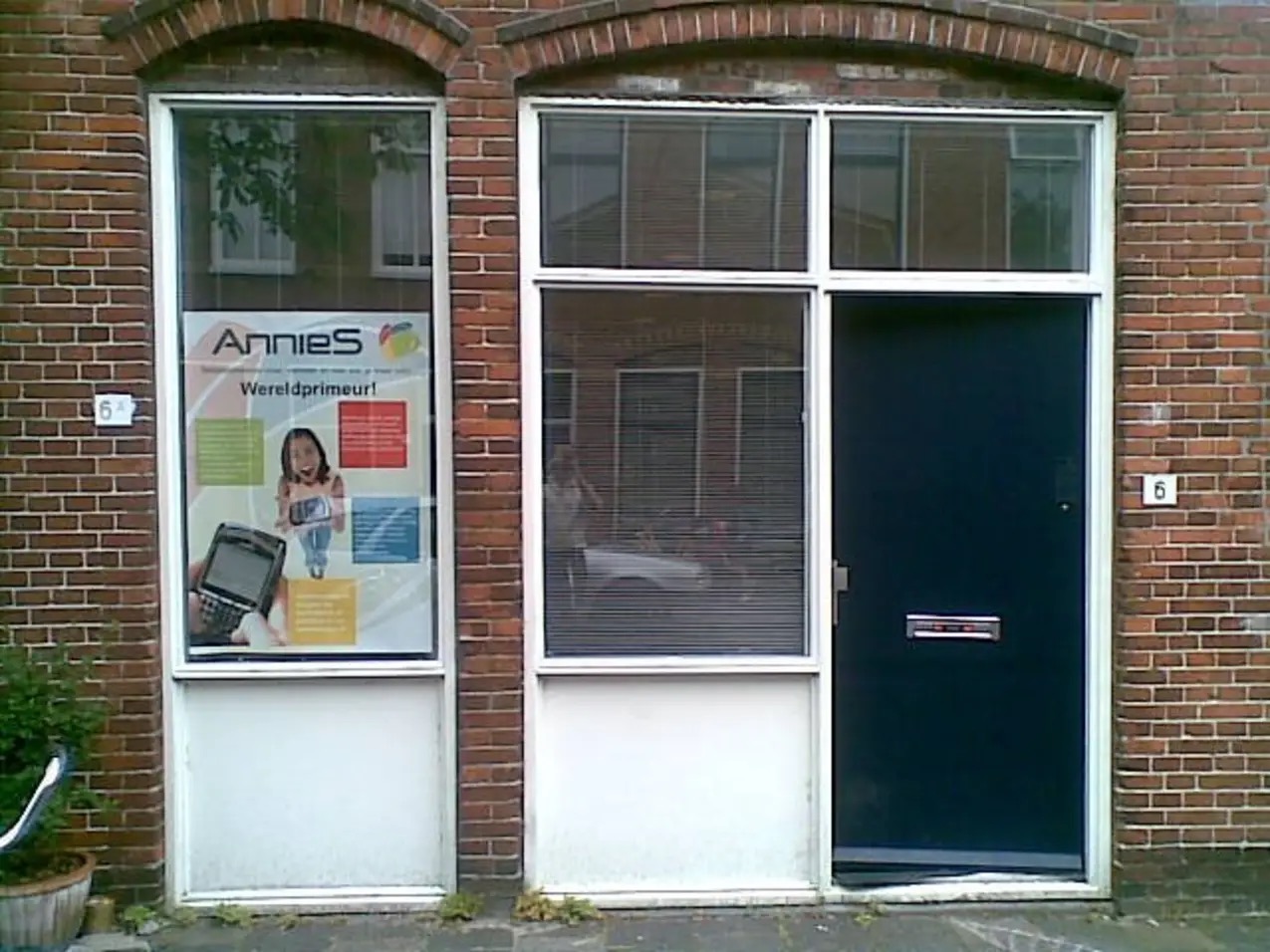
The rest of the report makes clear this was not an observational internship. In Week 2 I was revising business documents and building relationships with Dutch and Belgian clients while researching differences in telecommunications accessibility across Europe. In Week 3 I was studying universal service and functional equivalency and asking how those concepts might be adapted to improve service in the Netherlands. In Week 4 I was looking into the mechanics of the Dutch relay service itself and trying to identify elements that could be improved.
“We're connecting Deaf people to emergency svcs in the European Union! Pilot program in NL, FR, SWE, ES & UK. www.reach112.eu”
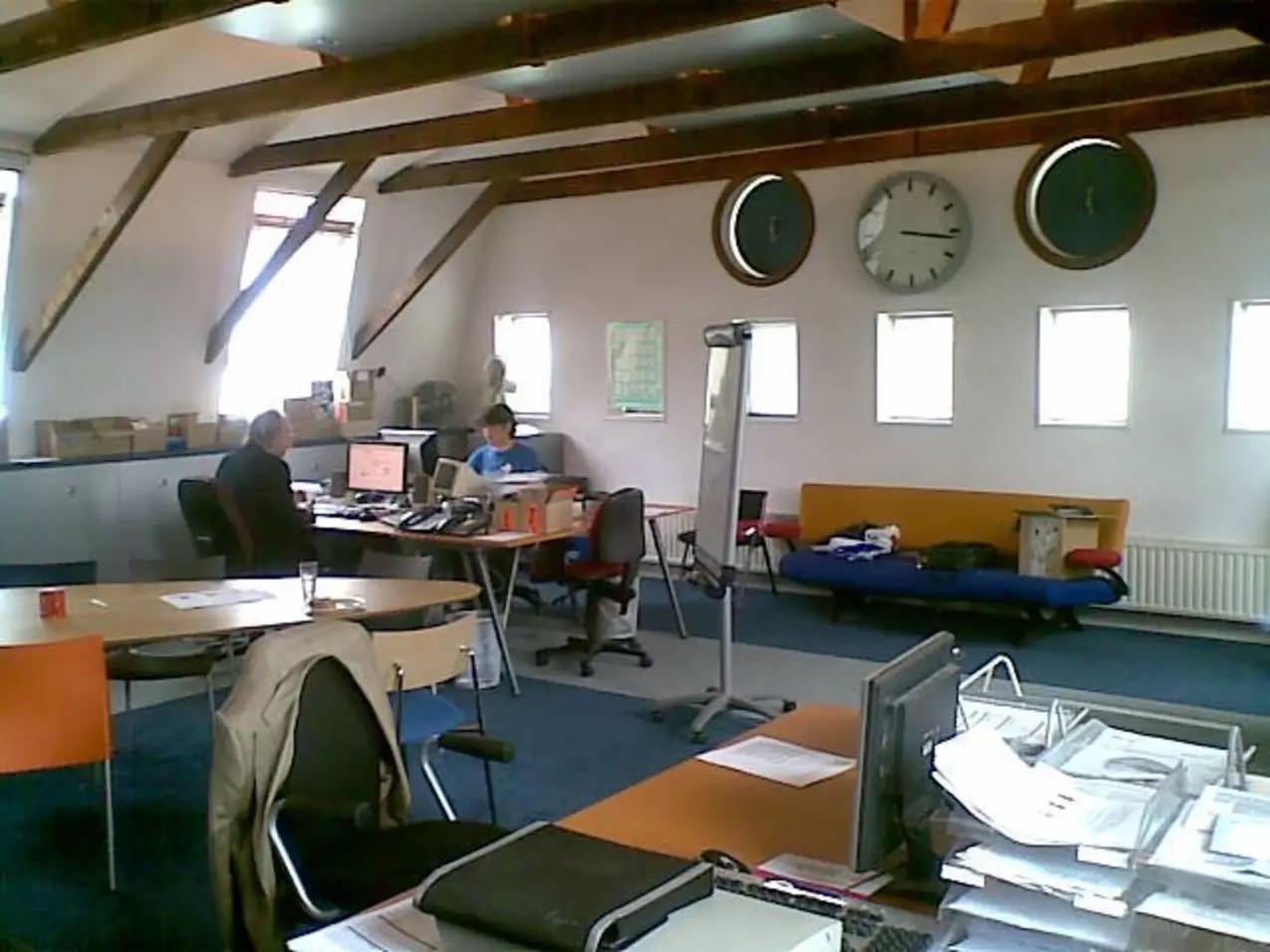
There was gloriously ordinary work too. At AnnieS's Amersfoort office I helped repair alarm flashers by replacing transistors on circuit boards, dealt with network-connectivity issues, and watched BlackBerry devices move through the assistive-equipment distribution system. Accessibility was not an abstraction. It had inventory, wiring, reimbursement, customer support, broken hardware and people waiting for it to work.
“Strippenkaart: NL's pass for trams & buses. Each stamp represents a certain distance and time. Confusing. It's how they keep tourists out.”
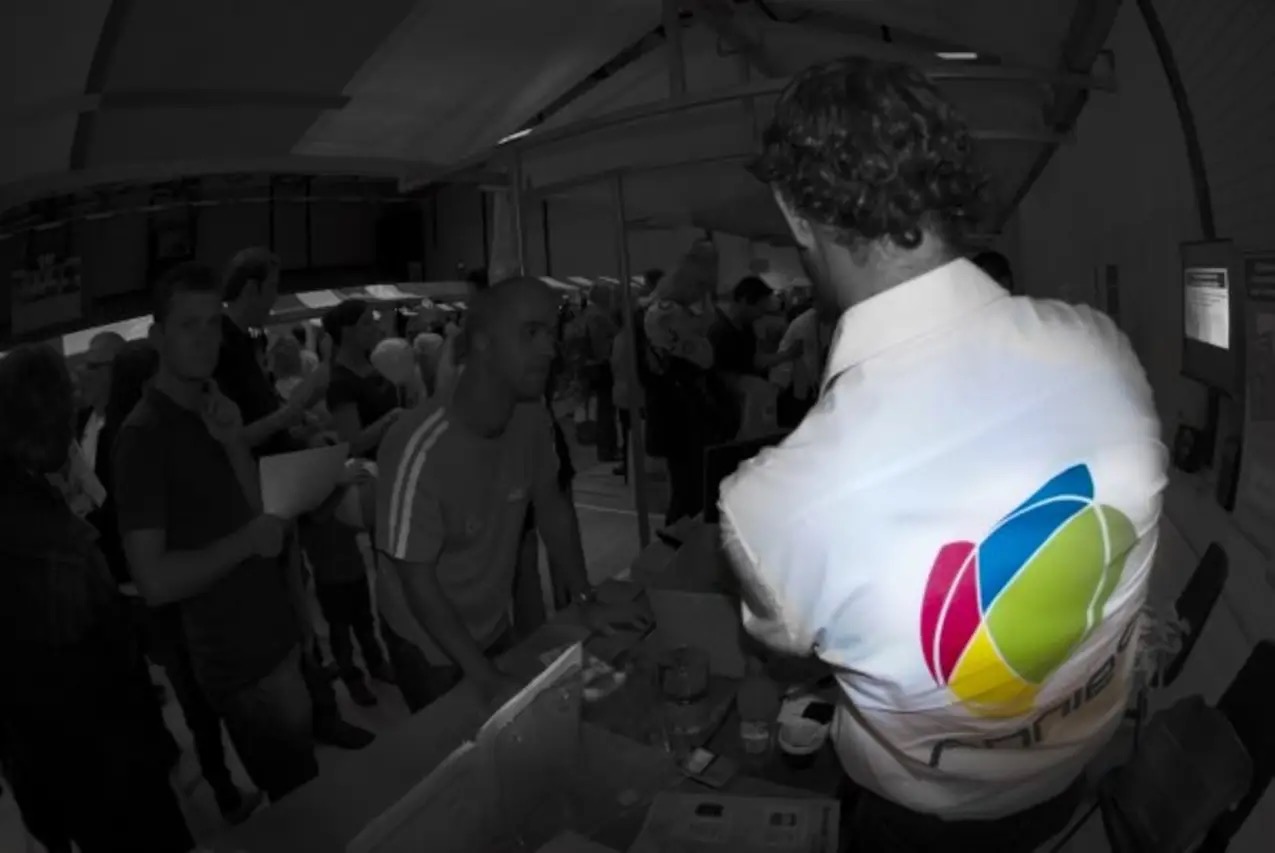
It also had a public face, and it pointed at the community rather than at the market. In 2009 I worked an AnnieS stand at Werelddovendag in Bergen op Zoom — World Deaf Day, the Dutch Deaf community's own national gathering. A striped tent in a sports hall, equipment and branded t-shirts on the table, and a queue in front of it.
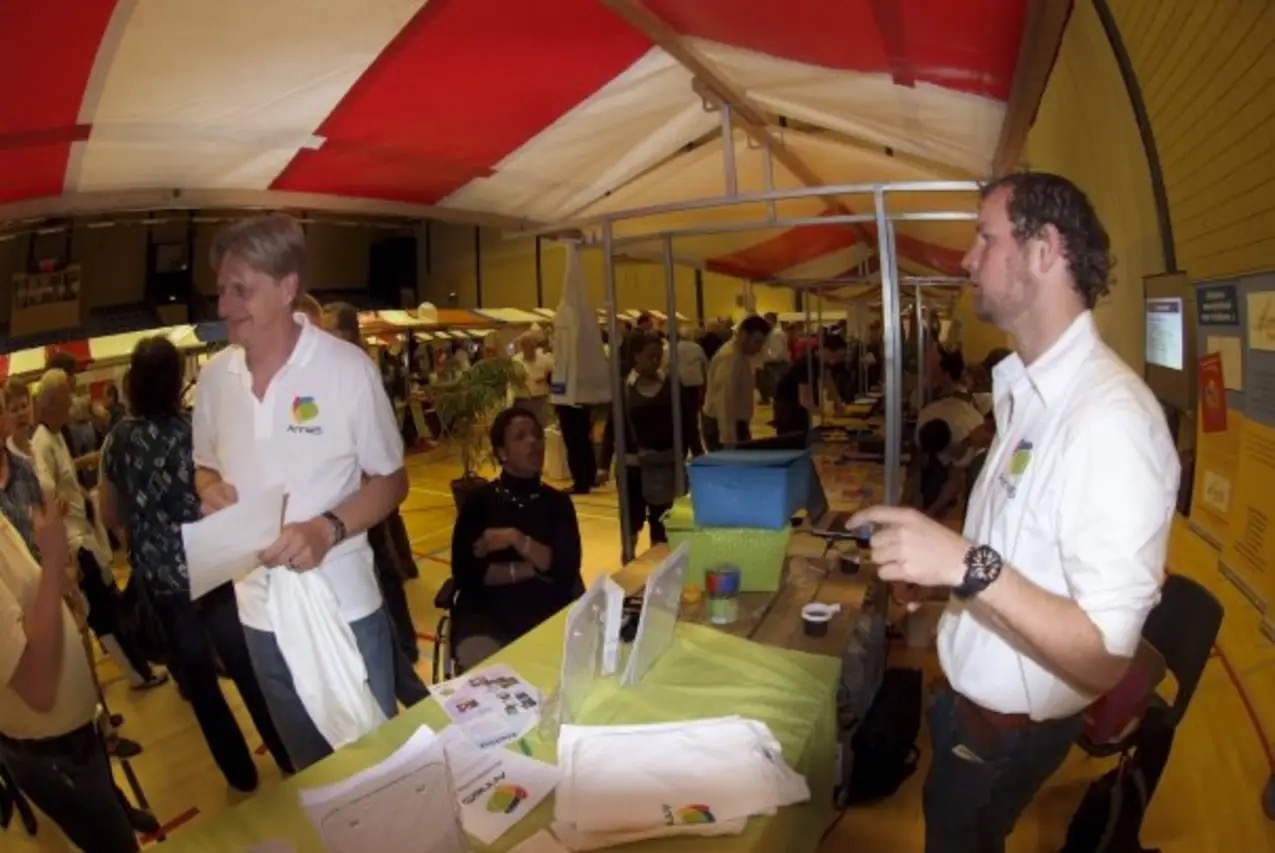
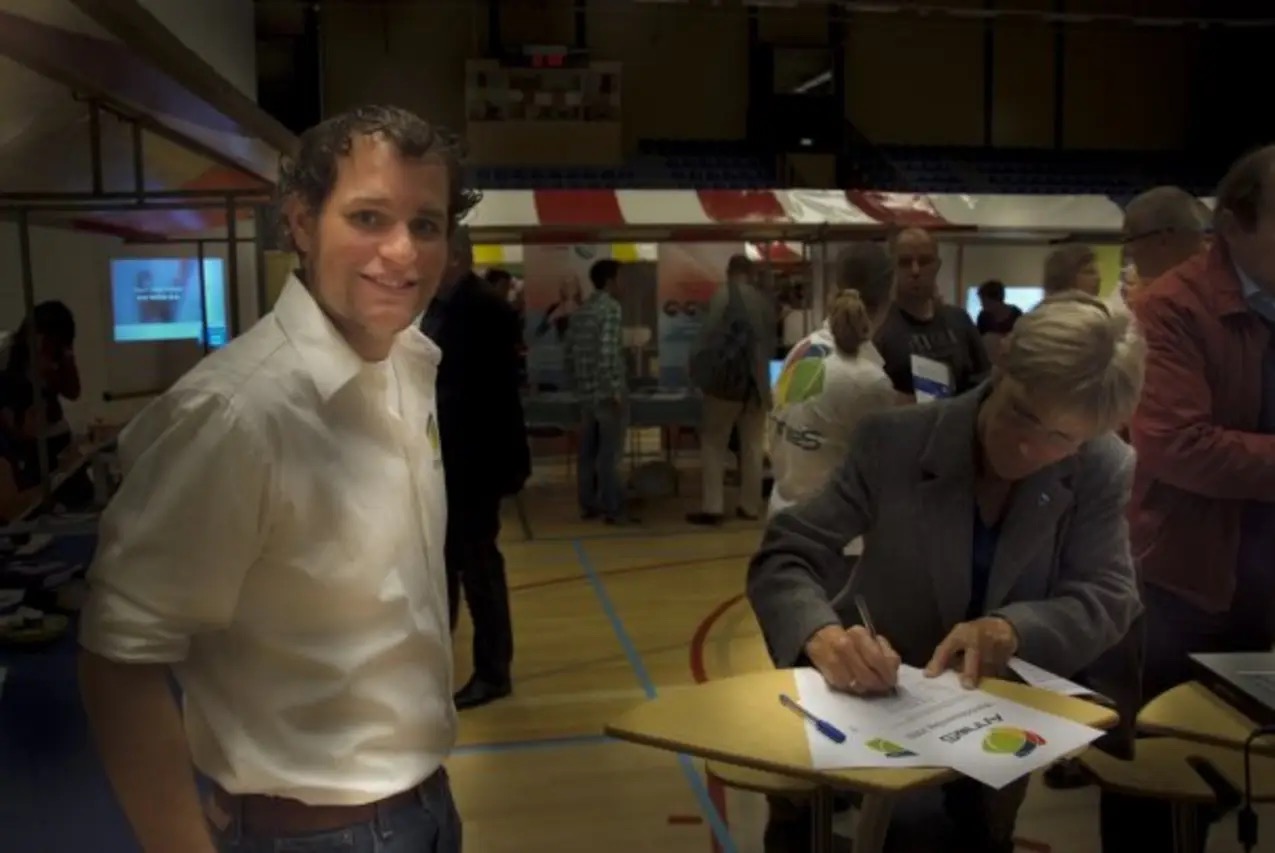
One frame from that stand survives twice. In the second copy the colour has been drained out of everything except the AnnieS logo on the back of my shirt — the ordinary work of standing behind a table, turned into a brand image.
“@ Fevlado (Flemish NAD) in Ghent, Belgium. As poppies grow in Flanders fields, we shall not sleep.”
The manifesto I forgot I wrote
Months later I wrote my formal internship report. Its first sentence now reads like a message sent forward in time:
“Without question, my aspiring career in International Deaf Telephony was jump-started by my recent internship experience at AnnieS in the Netherlands.”
The report compared Dutch and American approaches to regulation, reimbursement, assistive technology, Deaf participation in decision-making, and functional equivalency. I was trying to understand why one country produced one accessibility architecture and another produced something entirely different — and what could be carried across the border between them.
The conclusion was even less subtle. I wrote that my experience had prepared me for a career in Deaf telecommunications and that it was my mission to help ensure that Deaf people received functionally equivalent access to telephony.
I was twenty-four years old. I had forgotten that I had already named the work.
Two ideas that did not have to become one
AnnieS was one bet. DirectEye was another.
AnnieS was deeply invested in real-time text. DirectEye, the Belgian venture led by Johan Verstraete, increasingly centered video, visual communication, remote interpreting and direct calling. The archive shows us debating where RTT belonged, whether it should be bundled into DirectEye, and when a capability was strategic leverage versus a distraction.
That distinction matters because the story is not “we invented one perfect system.” It is people carrying ideas between different systems, sometimes combining them and sometimes deliberately keeping them apart.
The common principle was more durable than any particular device: communication should feel direct, interoperable and ordinary to the person using it.
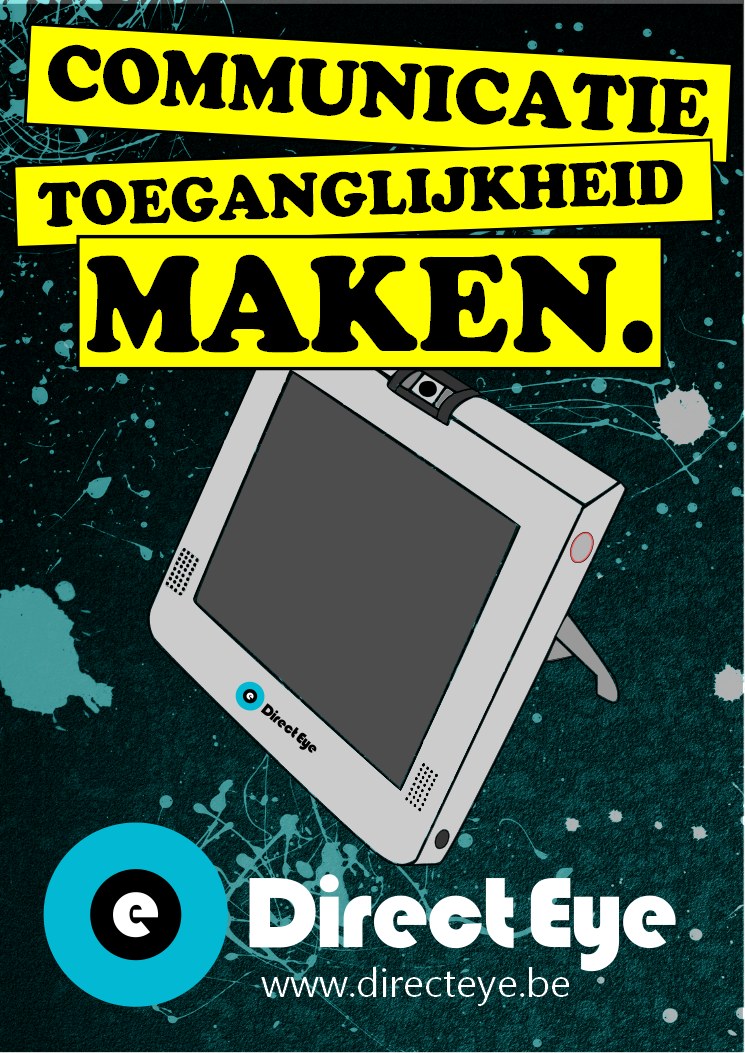
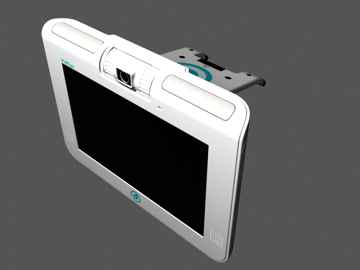
DirectEye said it out loud in its own promotional material: communicatie toeganglijkheid maken — making communication accessible. The archive holds two versions of that line. One is a poster built around the device itself. The other is a launch announcement with a date attached to it.
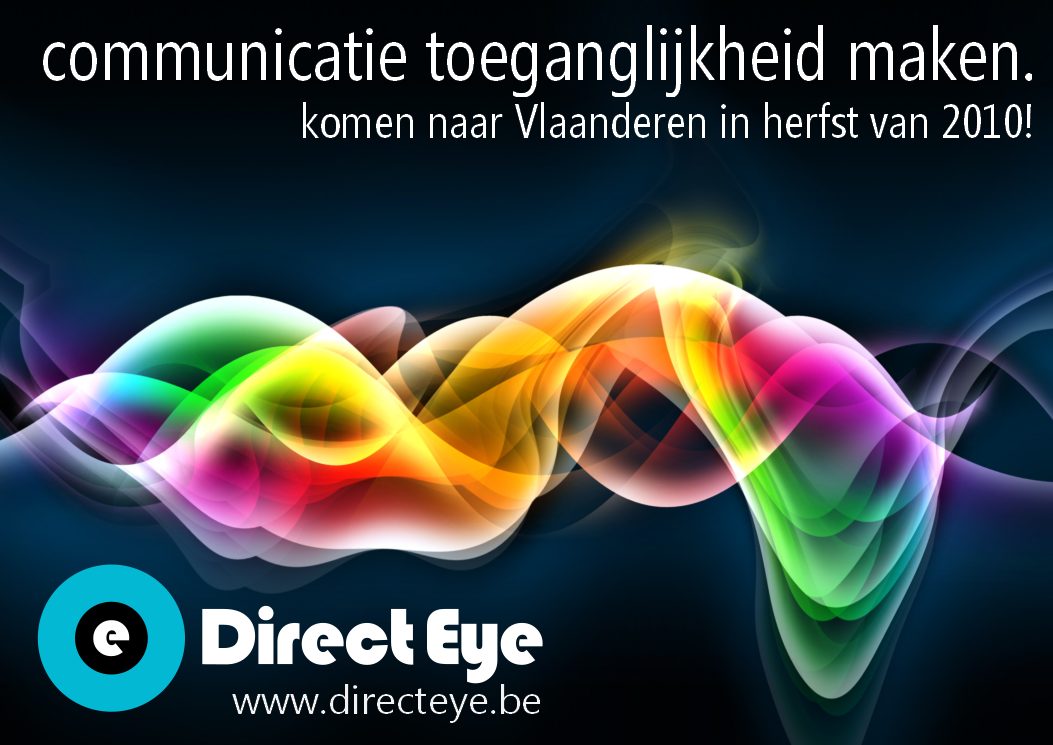
That second image dates the ambition. Months before the December 2010 email that pulled the United States into the thread, DirectEye was already telling Flanders a launch was coming.
Then America appears in the thread
On December 9, 2010, almost eighteen months after my first day at AnnieS, I wrote Raymond an email with the subject RTT and 911 in the USA.
I was working at TDI by then. The FCC had begun organizing around next-generation 911, and I could see where the accessibility conversation was moving. I told Raymond that RTT could play a key role in the emerging system and that I could help connect him and 4C Telecom with the people and information shaping that discussion.
Raymond replied that he was interested in exploring RTT in the United States and thought 911 could be the driver. He asked me to map the opportunity: partners, a rough business plan, the role of TDI, and what it would take for me to commit to the effort. He explicitly tied the request back to my time at AnnieS and our conversations in the Netherlands.
The bridge I vaguely remembered standing near was a bridge I had actually been asked to help build.
DirectEye gets real
By late December 2010, DirectEye's own internal website material identified me as Strategic Advisor — United States of America. The title was real. The work underneath it was much more hands-on than I remembered.
On January 9, 2011, I drafted service language for DirectTolk and DirectInterprète: Belgian telephone numbers, VidEye equipment, government sign-language interpreting and direct connections between visual communicators and hearing society.
Eight days later I sent Johan a project-management structure for the business: a project charter, responsibilities, a statement of work, separate Wallonia/Flanders/corporate workstreams, deliverables, cost and schedule estimates, objectives, stakeholders, chain of command and, finally, the investor proposal that tied it together.
On January 27, in an email simply titled DirectEye strategy, I laid out the rest of my lane: U.S. sponsors and partners, website content, IVèS technical coordination, interface feedback, marketing studies and whatever strategic support Johan needed next.
That role is visible again in a March chat after a strong IBBT session. Johan was thinking about office costs, sponsorship and how to accelerate the company. He reminded me, “you are strategic advisor right?”, told me the DirectEye team trusted me, and asked me to take the lead on sponsor outreach.
The archive has a better phrase for the job than any title I could invent now: I was a small transatlantic integration layer. Move information, technology and relationships between people who were not otherwise in the same room, then help turn the connection into something usable.
iBoot, an office, then investment
In March 2011, IBBT formally told DirectEye that its idea had passed the first iBoot selection. The next phase included recruiting, an intellectual-property scan, a video pitch, team formation and a final selection for that year's iBoot Camp.
Later that month Johan messaged me after an IBBT session: they were impressed, the video pitch had gone well, and the program was helping identify the people a young company needed around it — finance, management, development, interpreting and technical support.
By August, the emails looked different. Johan sent me photographs with the simple caption “Directeye new office :)”.
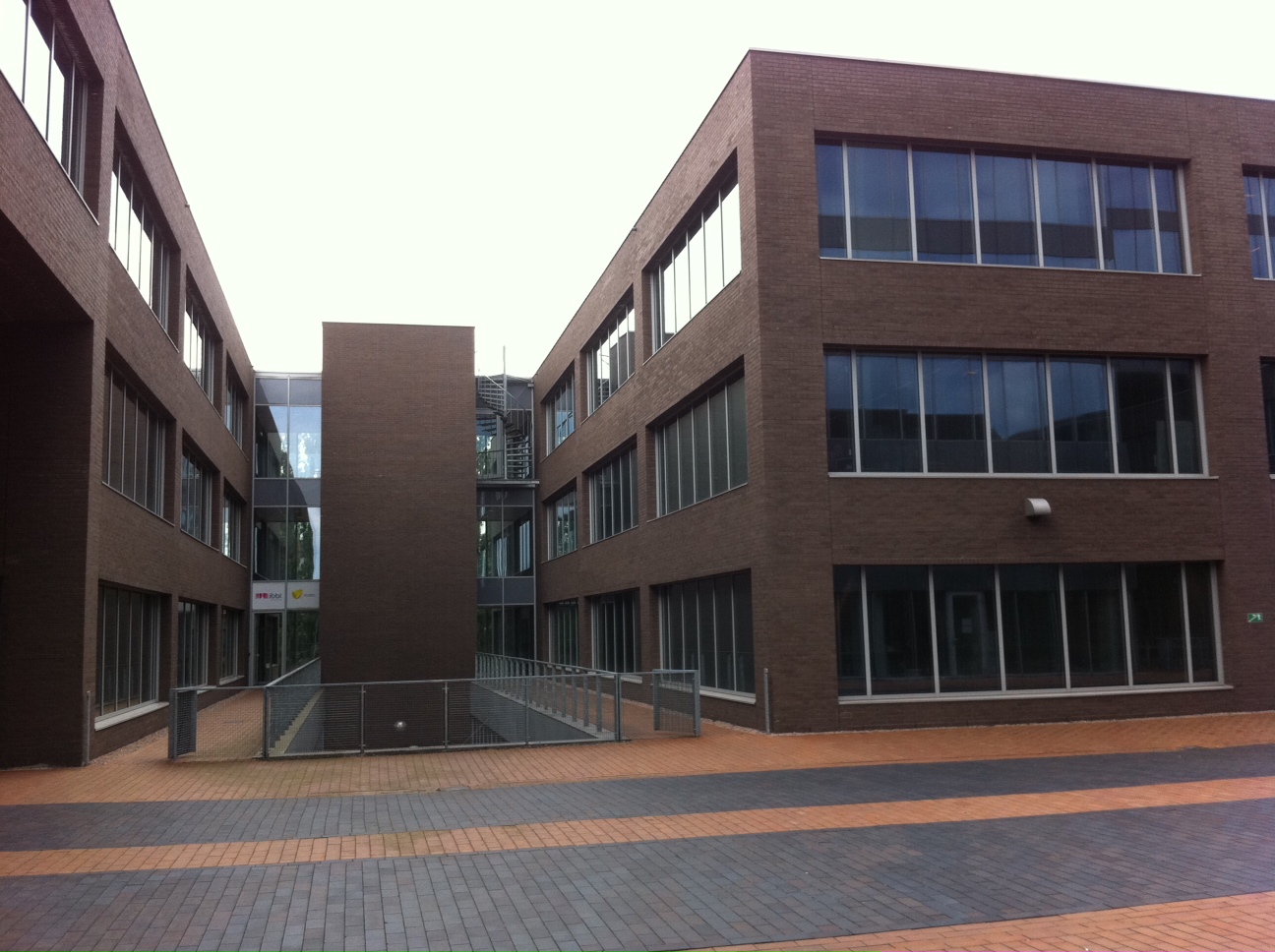
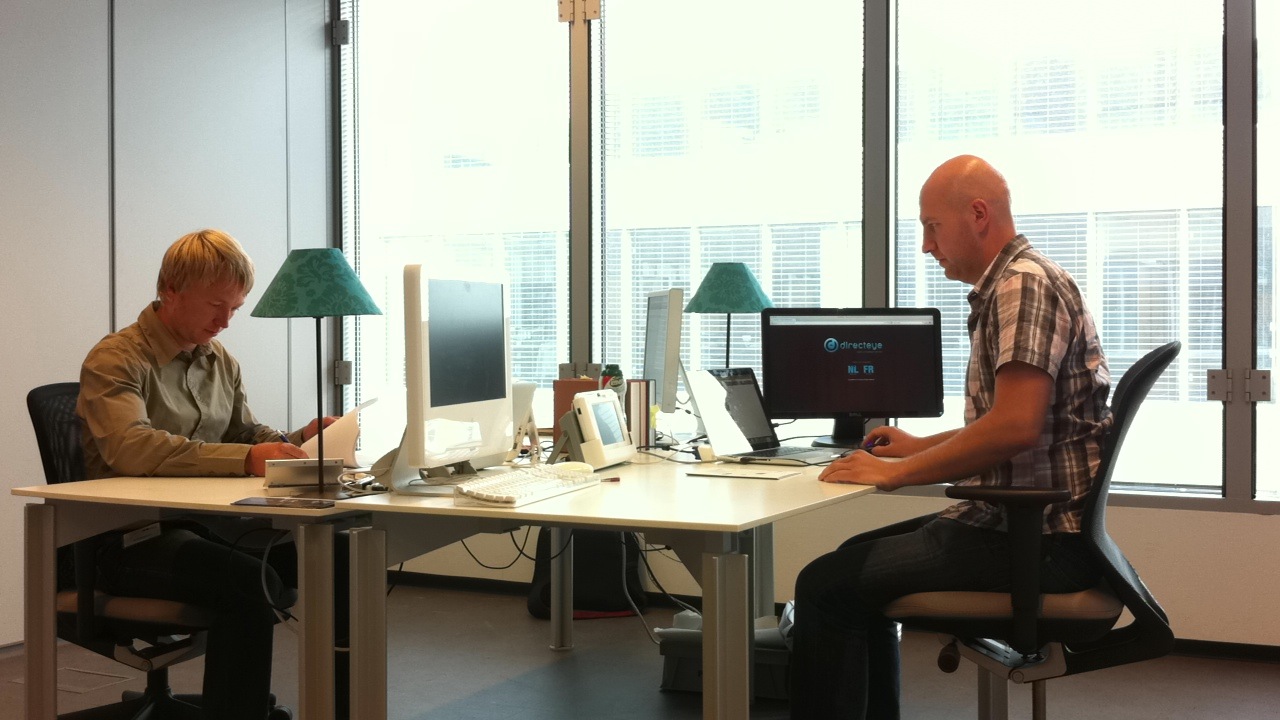
In September I was helping polish the English copy announcing the move into the iCubes business center. In October Johan sent me the IBBT press release.
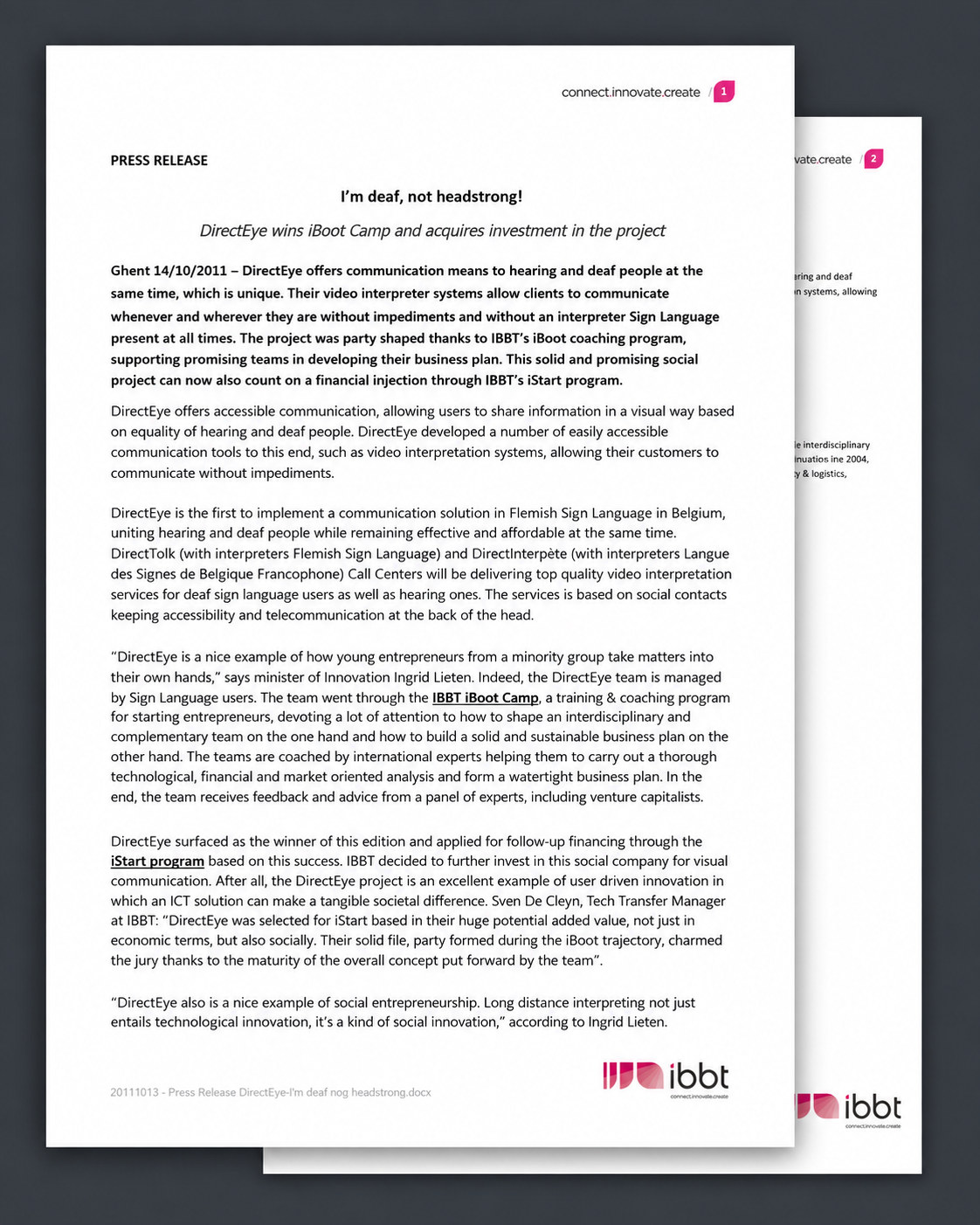
DirectEye had won iBoot Camp. IBBT selected the company for follow-on iStart financing. A surviving October 2011 DVO report independently confirms the investment and the company's move into offices at Gaston Crommenlaan 10 in Ghent.
I remembered DirectEye as a fascinating startup that almost happened.
That memory was wrong.
“@zflem May happen. FCC has asked about a shift to off-shelf equipment. VRS is a testbed toward future standards for video calling by hearies”
It was operating
By 2012, the surviving correspondence is no longer mostly about pitch language and prototypes. It is about operating a service.
In February, Johan sent me a detailed explanation of why DirectEye's video interpreters needed a controlled call-center environment. He discussed confidentiality, supervision, technical support, backup equipment, call handling and professional-team support. The use cases he named included government, municipal services, health care, emergency services, banks and workplace access.
In May he told me DirectEye had four new contracts, was officially providing four hours per week of VRS and planned to move to eight. The call center had two interpreters; he planned to add two more. He was preparing to move again because the existing call center was becoming too small.
Two days later we were talking about IVèS, Omnitor, Nwise, SIP, mobile clients, interpreter compensation and whether the faster business model was to sell direct video access to large companies rather than wait for government programs. Johan summarized the state of play in four words:
“technology ready — now focus on business models.”
That is the hinge. DirectEye had moved from asking whether Deaf people could build the thing to asking how to staff it, secure it, finance it, scale it and sell it.
Belgium was further along than I remembered
The public record fills in pieces that my inbox cannot. Surviving Belgian material describes DirectEye's VidEye and relay-service model, reimbursement advocacy in Wallonia and Brussels, equipment in use by Deaf organizations, interpreter recruitment for relay operations, and a later municipal remote-interpreting pilot in Liège.
The service design was unusually concrete. A Deaf user could dial an ordinary telephone number from a visual endpoint. The system would determine whether the destination was another compatible video endpoint or a conventional telephone number. When relay was needed, the interpreter layer was intended to appear automatically rather than forcing the caller to reconstruct the call manually around the accessibility service.
The goal was not “videophone as assistive gadget.” It was to make the accessibility layer disappear into the act of calling.
And the financing argument was equally important: if accessible communication was necessary to use a workplace, government service or business, the cost should not simply be pushed back onto the Deaf person standing in front of it.
The worlds start to separate
By mid-2012, the chapter was changing. My own work in the United States was getting busier. Johan and I were no longer in constant contact. In a July chat he told me AnnieS had gone bankrupt and that Nwise had taken over its relay activity. DirectEye, meanwhile, was still pursuing contracts, interoperability and a more business-facing model.
I got married. I eventually joined the FCC. The European chapter receded into the part of my memory labeled that was a wild time.
Then I found one more email.
Four hours in April
I started at the Federal Communications Commission in March 2014.
On April 17, 2014 at 12:21 p.m., I forwarded a detailed discussion of the FCC's proposed VRS neutral-platform and stand-alone communications-assistant architecture into my new FCC inbox.
At 4:40 p.m. that same day, I forwarded something else to the same address: the 2009 IVèS proposal Johan had sent me for the DirectEye VRI/VRS architecture — the old European material describing hosted service, subscriber profiles, Belgian public or virtual numbers and interpreter-side network requirements.
I do not have evidence that the FCC asked me to compare those systems, adopted the DirectEye architecture, or even knew why I had put those two records next to each other. The archive does not support that claim, so I will not make it.
What it does show is simpler and, to me, more interesting.
Less than a month after walking into the FCC, I deliberately put the contemporary American architecture debate and the European implementation material from five years earlier into the same work inbox, four hours apart.
That is where I will leave the thread for now.
What happened at the FCC afterward — direct ASL calling, ACE, MITRE, open-source contact-center infrastructure and eventually a much larger institutional accessibility program — is another chapter. It matters. But it is not the point of this one.
This one belongs to Groningen and Ghent.
What the record supports — and what it doesn't
Memory is generous to us. Archives are less so. That is why this reconstruction matters.
The surviving record supports a clear historical claim: in 2009 I worked inside the AnnieS environment in Groningen with an explicit assignment to help expand RTT in the United States; I spent time in Ghent and elsewhere in Belgium while building relationships with Dutch and Belgian clients; I researched European telecommunications accessibility, universal service, functional equivalency and the Dutch relay system; and I later worked with AnnieS leadership on a U.S. RTT/NG911 opportunity. My surviving Twitter archive provides a contemporaneous record of those Belgian sojourns alongside the internship material and correspondence.
It also supports a second claim: I served as DirectEye's U.S. strategic advisor and was actively involved in service definition, project structure, sponsor strategy, IVèS technical coordination, product feedback, communications and the company's transatlantic relationships. By 2012, contemporaneous conversations describe contracts, scheduled VRS hours, interpreters, call-center capacity and operating policy.
The record does not prove that I caused the Direct Video Calling transition in the United States, authored later standards, or that DirectEye became the architectural basis for later FCC systems. Those are larger causal claims and would require larger evidence.
The more interesting story does not need them.
Why this history disappears
Accessibility technology has an archival problem.
Small companies vanish. Domains expire. Product pages disappear. Startup names get absorbed into larger firms or simply stop resolving. Standards survive, but the human network that pushed them into existence often does not. Deaf-led innovation is particularly vulnerable to this kind of erasure because so much of the work happens in small organizations, prototypes, community relationships, side conversations and advocacy networks long before a regulator produces a clean PDF with an adoption date.
Sixteen years later, the public internet contains fragments of AnnieS and DirectEye. My inbox contains the connective tissue.
That should not remain private archaeology.
The work now is preservation
So this is the beginning of a reconstruction, not the conclusion of one.
I want to preserve the proposals, photographs, product material and correspondence; recover the conference records and public filings; trace the standards work; and talk to the people who were there while those memories are still available. I want to separate what we hoped would happen from what actually happened and put names and dates back around the technology.
There is a larger history here about how accessible communications crossed borders before most people were talking about accessibility as infrastructure. It belongs to more people than me, and it deserves a record better than a handful of broken URLs.
I went looking for evidence that an old adventure had really happened.
Instead I found a younger version of myself, moving between Groningen and Ghent and later sitting in Washington, already trying to solve the same underlying problem: how do you move an accessible idea from the edge of the system into the system itself?
Apparently, I have been working on that question for longer than I remembered.
Source note: This essay is reconstructed from contemporaneous correspondence, photographs, internship reports, my surviving Twitter archive and project material in my personal archive dated 2009–2014, including exchanges with AnnieS, DirectEye, IVèS and TDI contacts; AnnieS office photographs and photographs from Werelddovendag 2009 in Bergen op Zoom; DirectEye promotional artwork and website/project records; and the 2011 IBBT DirectEye press release. The Belgian reconstruction also draws on surviving public material from Deaf-community archives and contemporary Belgian reporting. Statements attributed to people in private correspondence are presented as contemporaneous accounts, not independent verification of every underlying event. I am continuing to recover and cross-check the record.