How do I get a printed copy?
“You can order artist/researcher signed copies of all seven maps from www.macrovu.com for $500.00 plus shipping and handling.”
A story about Robert E. Horn, seven giant maps, and what happened after I stopped walking.
I went looking for seven posters. I found a language.
A hallway in the Language Creation and Learning Lab at Johns Hopkins, 2026. Wall-sized argument maps by Robert E. Horn, 1998. The video is ambient — there is no speech in it.
00The Encounter
I wasn't looking for Robert E. Horn.
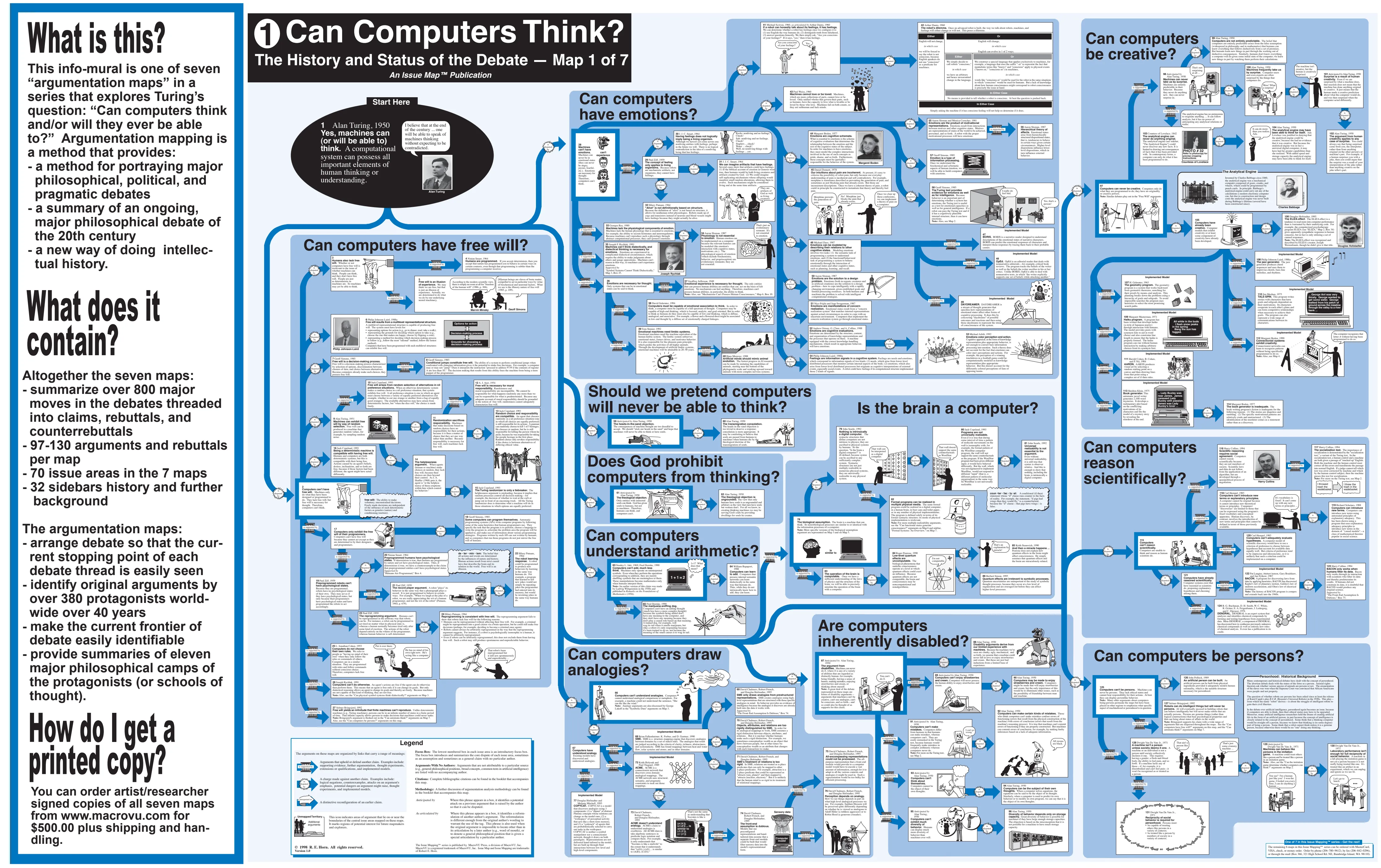
I was walking through the Language Creation and Learning Lab at Johns Hopkins University when I encountered a series of enormous argument maps hanging in the hallway. At first I understood them as posters. Then I stood in front of them for a while.
Something strange happened. I could almost see the loops moving. Claims pointed toward other claims. Some supported them. Others attacked them. Arguments split, doubled back, changed level, or disappeared into territory the map admitted it had not covered. Emotion, reason, utility, consciousness, disability, symbol systems — everything occupied space and acquired relationships.
I use American Sign Language. I already knew that space could carry meaning — that a later move can rely on a spatial relationship established earlier. The wall was doing that.
Not literally. They were models of a historical debate. But they were models in which enough of the argumentative structure had been made explicit that you could inspect it, traverse it, and ask what kind of formal object might be hiding underneath.
01The Object
Arguments that uphold or defend another claim. Examples include: supporting evidence, further argumentation, thought experiments, extensions or qualifications, and implemented models.
is disputed byA charge made against another claim. Examples include: logical negations, counterexamples, attacks on an argument's emphasis, potential dangers an argument might raise, thought experiments, and implemented models.
is interpreted asA distinctive reconfiguration of an earlier claim.
As articulated byA reformulation of another author's argument, different enough from the original wording to warrant the tag.
Anticipated byA potential attack on a previous argument that is raised by the author so that it can be disputed.
Unmapped TerritoryAreas of argument that lie on or near the boundaries of the central issue areas. “It marks regions of potential interest for future mapmakers and explorers.”
02The Hook
That was the first clue. A line on these maps does not merely connect two boxes. It says what kind of connection it is.
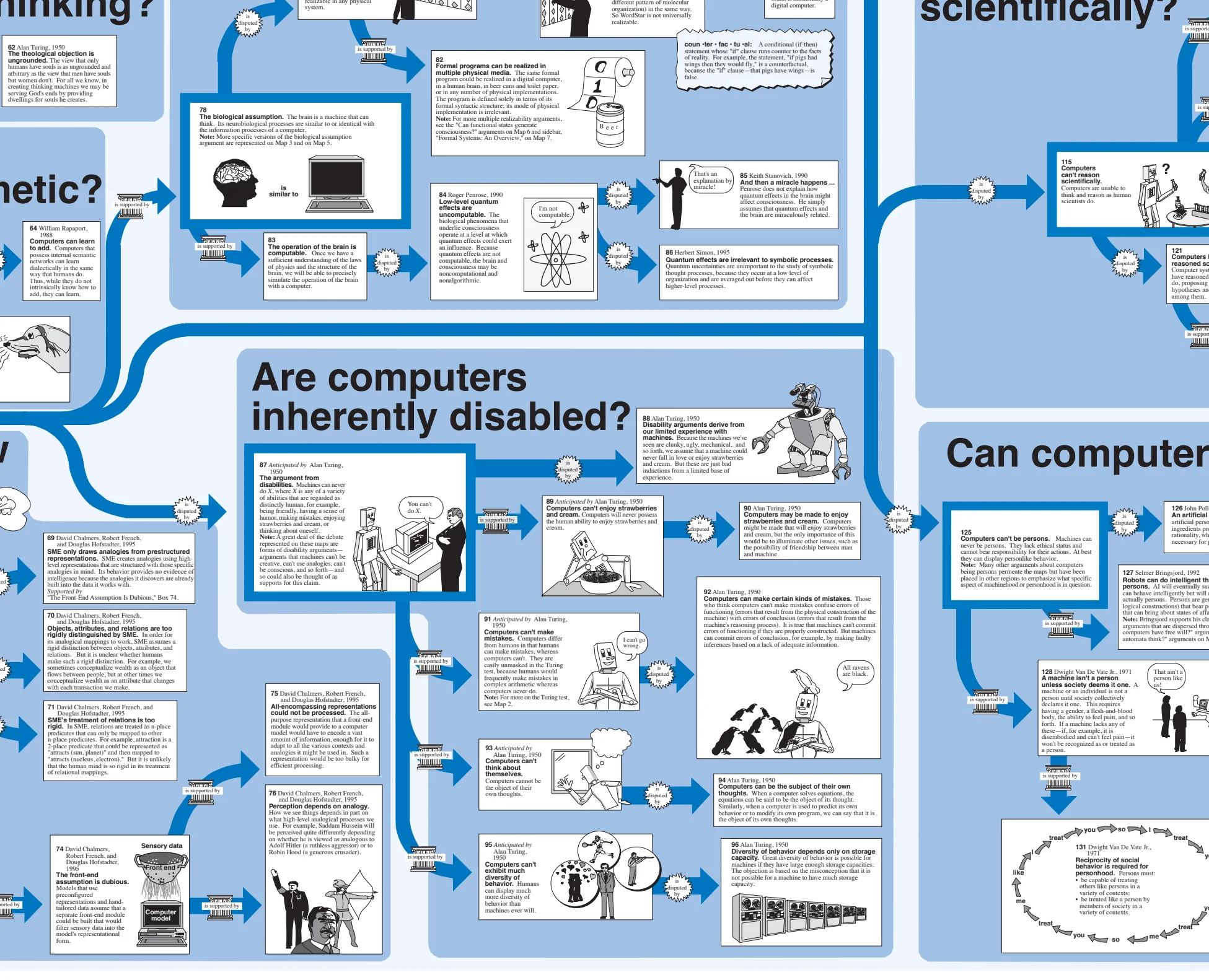
One region stopped me. Horn groups a family of claims under a question that hit differently: Are computers inherently disabled?
I am Deaf. Much of my professional life has been spent at the boundary between people and machines — what channels exist, what channels do not, what information can move, and what happens when it cannot. Here was a map from 1998 treating Turing's “argument from disabilities” not as an isolated quote but as part of a network: creativity, emotion, self-reference, scientific reasoning, personhood, mistakes, humor, strawberries and cream.
I wanted the maps.
“You can order artist/researcher signed copies of all seven maps from www.macrovu.com for $500.00 plus shipping and handling.”
The surviving material still pointed to MacroVU. I wrote to the ordering address.
Primary record · author correspondence · August 30 – September 2, 2026. Four fragments, quoted with Horn's permission. The full messages are private and are not redistributed.
“Your message wasn't delivered.”info@macrovu.com
The maps “no longer exist in printed form.” Horn offers to send the PDFs.
“You have my permission to print them.”
“Of course, I'm interested in what makes you want to study the history of the Turing argument.”
Cheers
Bob
Robert E. Horn
Fellow, World Academy of Art and Science (WAAS)
Senior Researcher (ret.), H-STAR · Stanford University
Founder, WAAS Working Group on Existential Risks to Humanity
bobhorn.us · historical address
Preserved in the Horn archive
“Here is the PDF of Map 1. Let me know your receipt and I will send more.”
“Feel free to share the documents and maps with others.”
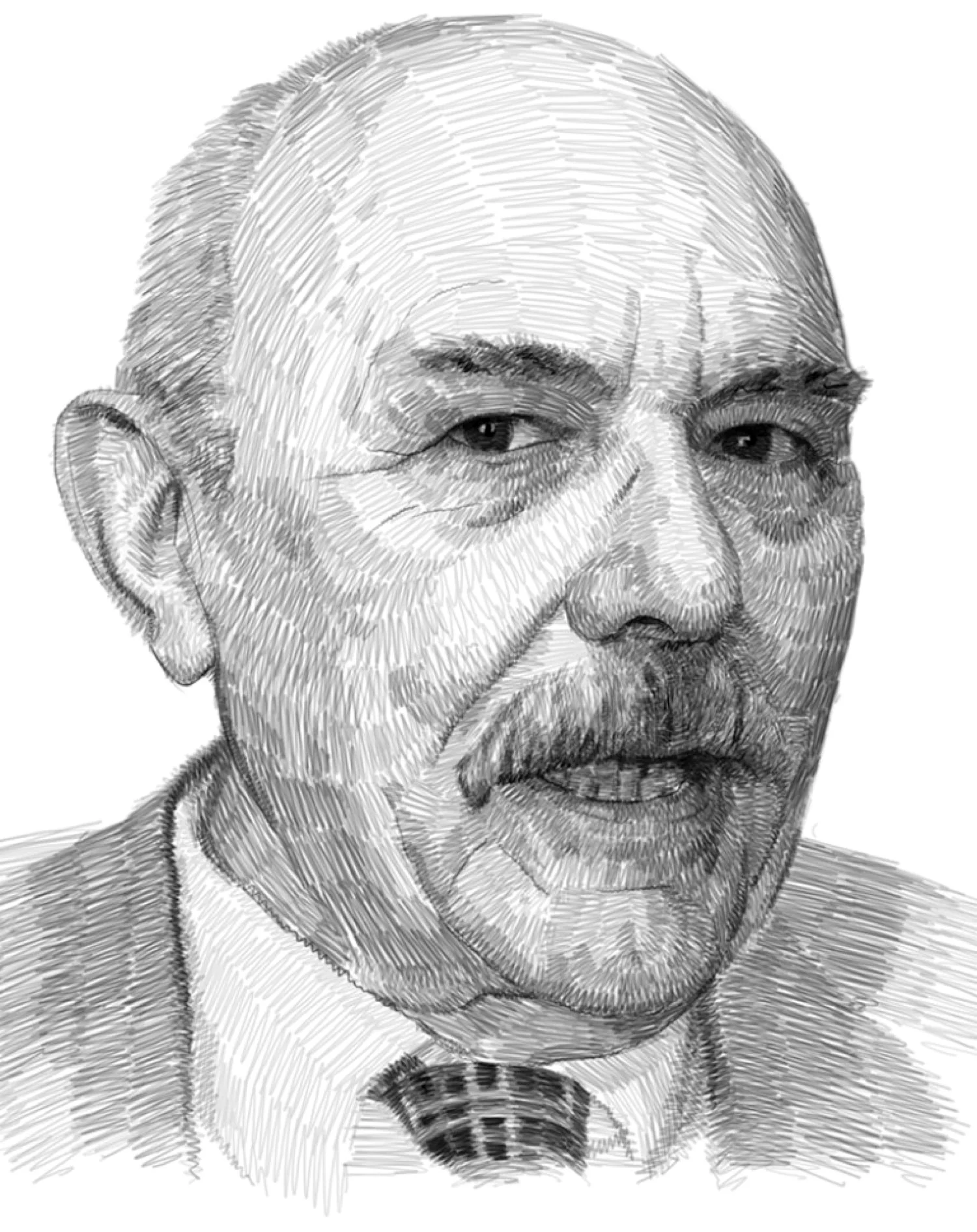
Only after I contacted him did I understand the scale of the career behind the hallway maps. Horn developed the Information Mapping method, founded Information Mapping, Inc., taught at Harvard and Columbia, and later worked as a visiting scholar at Stanford.
In 1998 MacroVU published Visual Language and Mapping Great Debates: Can Computers Think?. By 2026 the printed sets were gone. MacroVU's order desk was a dead address. The work was still his.
So I tried the improbable next move: I wrote to Horn himself.
I had started with a preservation problem: how do I recover a set of giant intellectual objects that are no longer in print? Now I had something richer — the source material, the surrounding theory, and the person who had made the work telling me to keep going.
03The Material
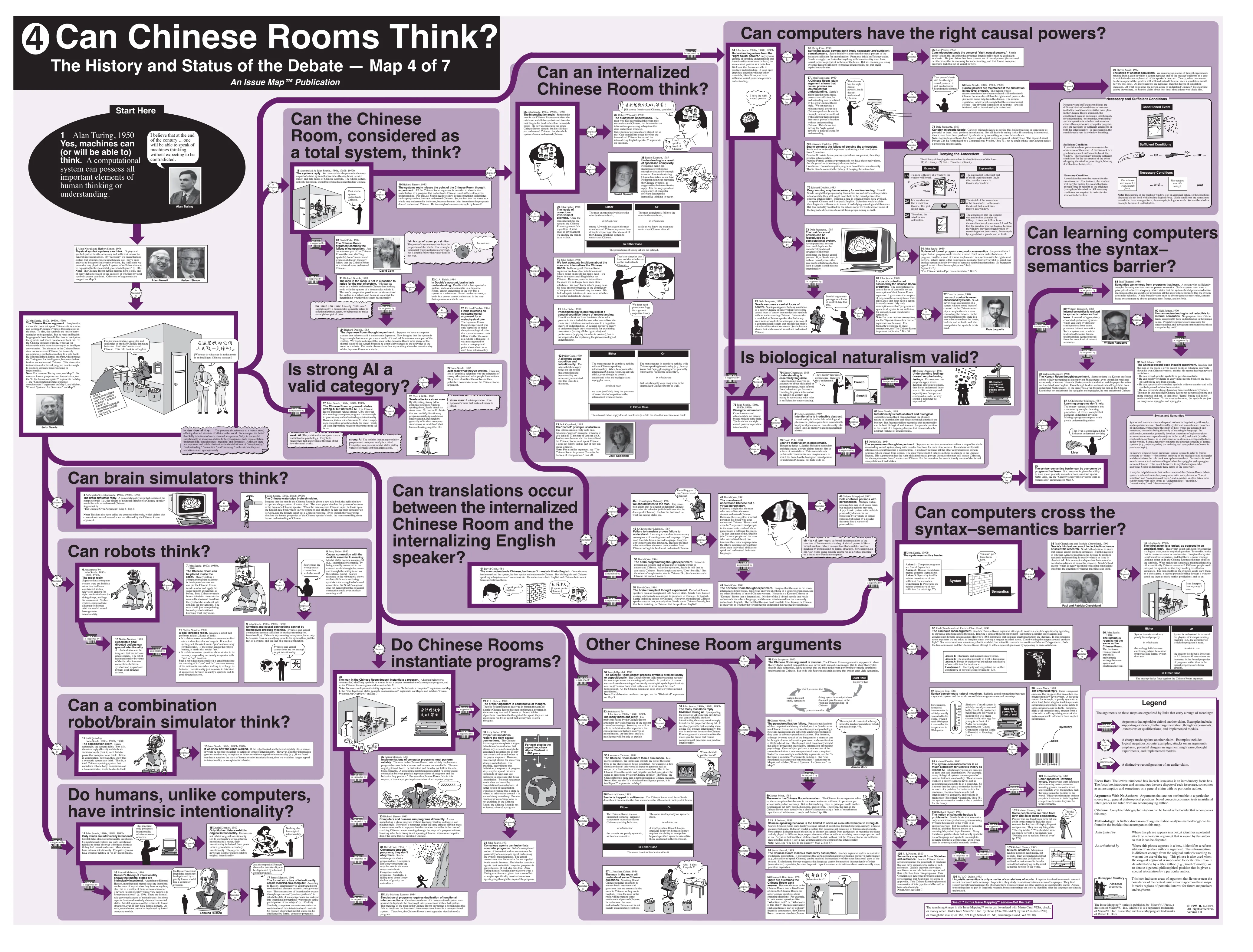
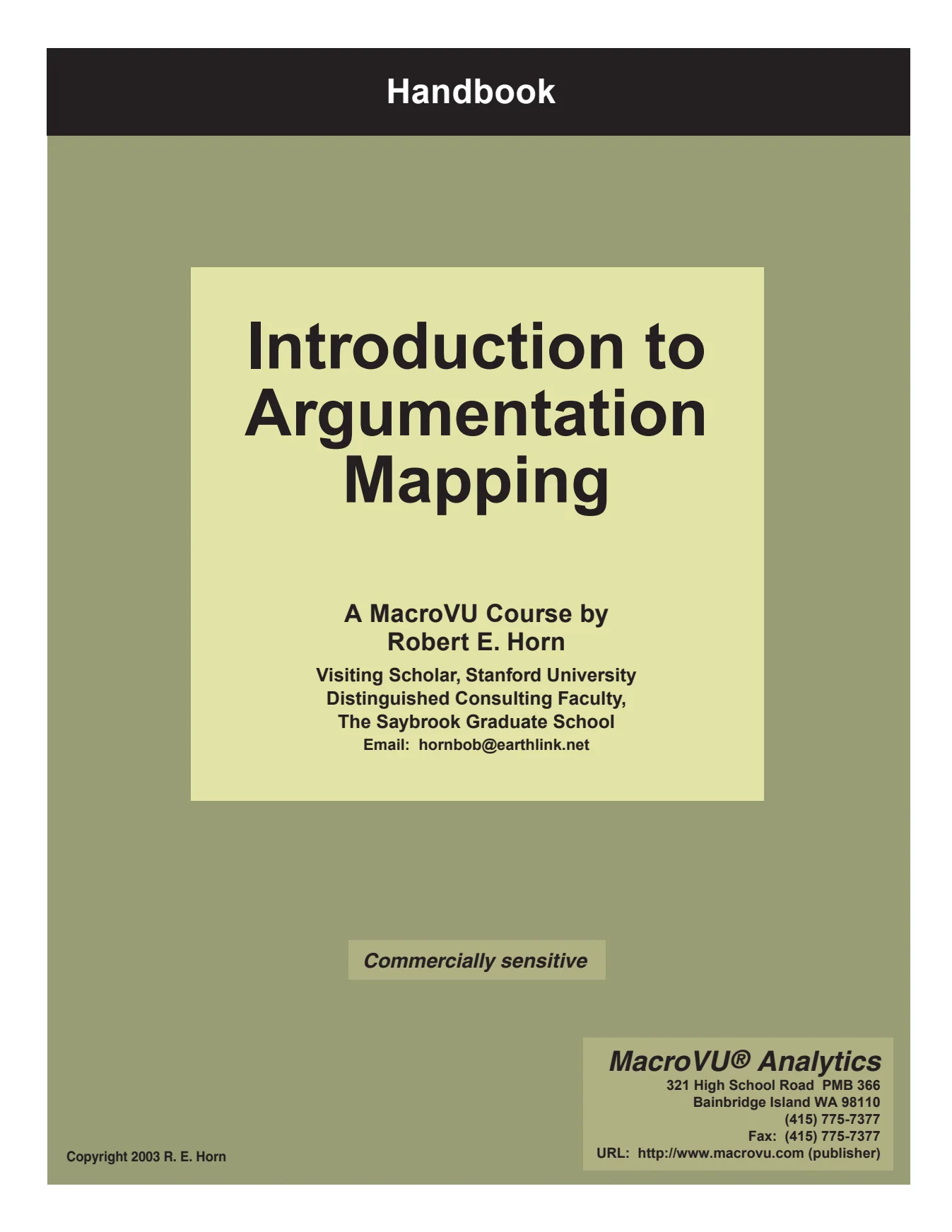
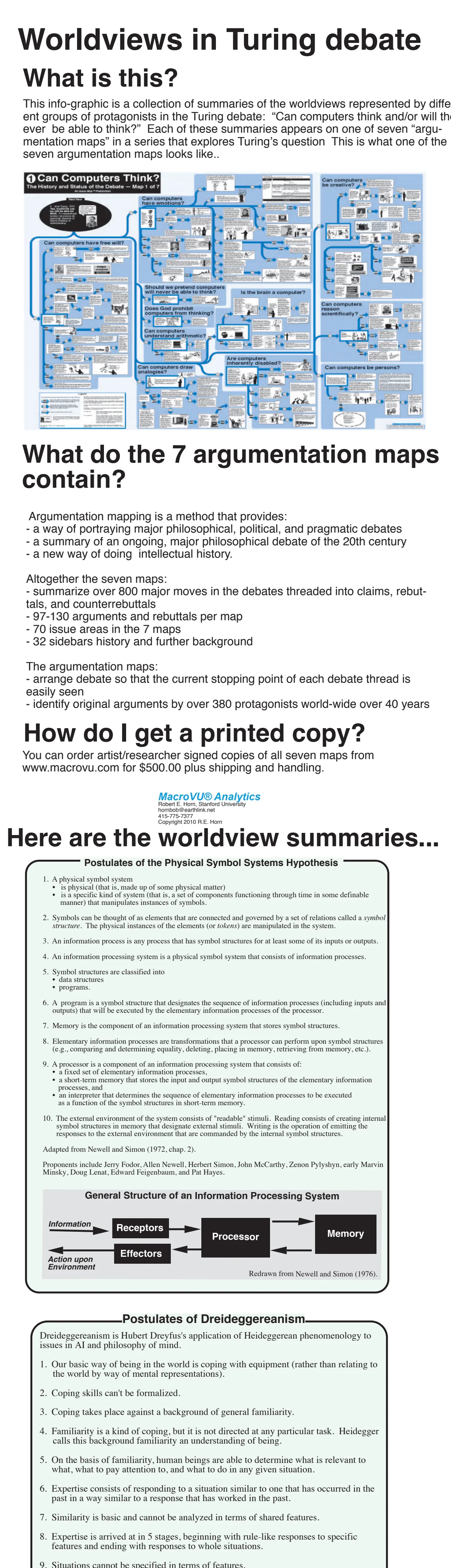
Representative sample. The full inventory belongs in the Horn library and audit surfaces.
| # | Artifact | Boxes | Issue regions | Arrived | Fingerprint |
|---|---|---|---|---|---|
| 1 | Can Computers Think? | 131 | 11 | Aug 31 | bc506c77 |
| 2 | Can the Turing Test Determine Whether Computers Can Think? | 110 | 10 | Sep 1 | 608581d0 |
| 3 | Can Physical Symbol Systems Think? | 125 | 12 | Sep 1 | a69786ae |
| 4 | Can Chinese Rooms Think? | 105 | 14 | Sep 2 | d79abebd |
| 5 | Can Connectionist Networks Think? Can Computers Think in Images? | 118 | 13 | Sep 2 | 82d30e6f |
| 6 | Do Computers Have To Be Conscious To Think? | 97 | 8 | Sep 2 | ec96be13 |
| 7 | Are Thinking Computers Mathematically Possible? | 122 | 10 | Sep 2 | 0a5ed69e |
| — | Can Computers Think? handbook, MacroVU 1998 · complete bibliography, pp. 12–19 | 487 works | — | Sep 2 | local PDF |
| — | Worldviews in Turing debate sheet | 85 postulates | 12 sets · 5 panels | Sep 2 | a786e164 |
| — | Introduction to Argumentation Mapping, MacroVU 2003 | — | — | Sep 2 | local PDF |
“Altogether the seven maps summarize over 800 major moves in the debates threaded into claims, rebuttals, and counterrebuttals — 97–130 arguments and rebuttals per map — 70 issue areas in the 7 maps — 32 sidebars … original arguments by over 380 protagonists world-wide over 40 years.”
Preservation forced the issue.
Once you see that, the posters stop looking like elaborate infographics.
The recovered material extends beyond the seven posters. The maps were not pictures.
04 Reconstruction Proof · 1998 print master → derived corpus
No embedding similarity. The historical text itself admits the connection.
We are not inferring a modern semantic graph from topical similarity. The print masters control identity and topology. The graph admits what the maps actually say — and only that.
Two more of the eight typed cross-map bridges. Each one is a sentence Horn printed inside a box. “Also see” and “Compare” references stay navigation; only printed support and dispute become argument edges.
Map 2 Box 24 prints: Supported by “The Chinese Room Is More Than A Simulation,” Box 55, Map 4.
Map 6 Box 12 prints: Supported by “The Turing Test Is an Adequate Test of Thinking,” Map 2, Box 2.
808 of 808 numbered boxes and 78 issue regions admitted with their printed numbers and poster coordinates, from seven fingerprinted print masters.
Horn's three printed link meanings are the only relation vocabulary: 295 supported by, 503 disputed by, 4 interpreted as. Untyped “Start Here” arrows stay navigation.
802 within-map relations traced visually against the sheets; 8 cross-map bridges admitted only where a box prints the reference.
Every map checks as one connected, acyclic graph rooted at its first claim, each later claim carrying exactly one incoming Horn relation, with two printed exceptions recorded.
Horn did not begin argument mapping from zero. Stephen Toulmin's 1958 The Uses of Argument gave argument analysis a vocabulary of claim, data, warrant, backing, qualifier, and rebuttal. In 1970 Werner Kunz and Horst Rittel's Issues as Elements of Information Systems organized difficult planning discourse around issues, positions, and arguments. The current eScholarship record is retained as a second institutional route.
Horn's distinctive move was to combine argumentative structure with historical synthesis, visual-language theory, information design, and wall scale. His own 2003 handbook still teaches claims, grounds, warrants, backing, and rebuttals — Toulmin's parts — as the anatomy of a box.
There was another reason Horn's work felt unusually legible to me.
I use American Sign Language.
That recognition has its own intellectual history. At Gallaudet in 1960, William C. Stokoe's Sign Language Structure challenged the assumption that signing was merely a loose visual substitute for spoken language. Stokoe showed that signs could be analyzed through formal components — handshape, location, and movement. Visual-spatial language had structure.
Later research goes further: signing space itself can carry linguistic structure. Referents can be associated with locations and later recovered through those loci; spatial relationships can become part of an utterance. The surface in front of a signer can retain context.
Horn's visual language and ASL are not the same thing. That does not make Horn's system “ASL on paper.” They are different things.
A visual language can be systematic without being serialized like prose.
I already knew from ASL that space can participate in meaning and retain context. That recognition helps explain why Horn's maps looked immediately legible to me: concepts can occupy a field, relationships can have direction, and a later move can rely on a spatial relationship established earlier.
That is the point at which the work stopped feeling merely historical to me.
These two lines do not touch. No document I have found shows Horn drawing on sign-language linguistics, or Stokoe's successors drawing on information mapping. The connection is the one I made standing in the hallway.
At Stanford's seminar on People, Computers, and Design, Horn argued that a new language was growing up around us, composed of words and images “tightly coupled” — so closely integrated that in many situations we cannot do without either — and described the need to understand its “systematics — its grammar and semantics.”
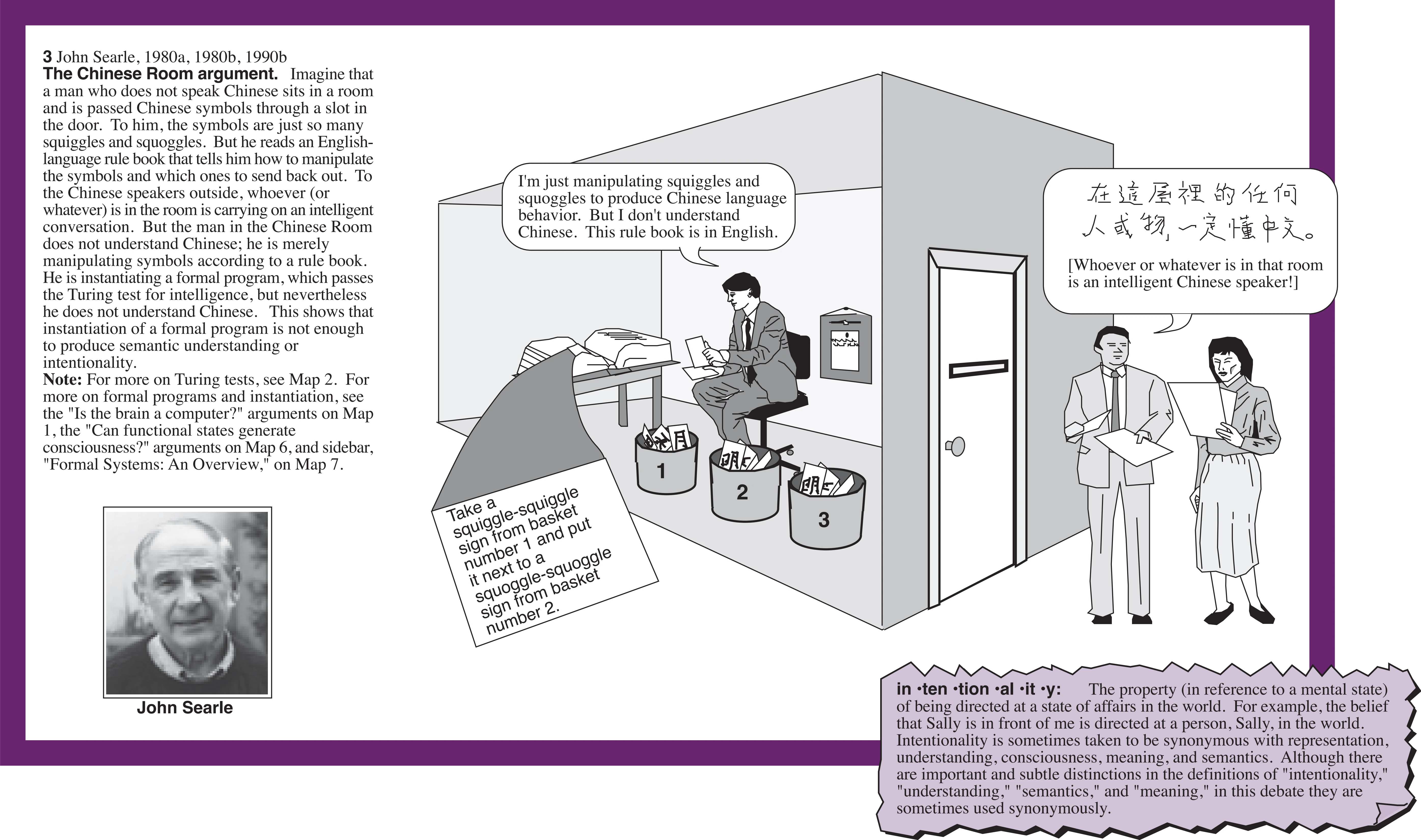
Searle's thought experiment becomes a navigable field of systems replies, internalization, brain simulation, syntax–semantics arguments, robotics, learning, and biological naturalism.
Everything above this line concerns Horn's work, its intellectual context, or our documentary reconstruction of it. Everything below it is an extrapolation.
Horn did not build my compiler. He did not design an executable semantic graph runtime, a game engine, or a contemporary AI provenance system. Those are new proposals.
What Horn did build is more interesting than pretending otherwise: a sustained theory and practice of visual language; methods for structuring information; massive argument maps with explicit, typed relationships; and wall-sized visual fields intended as serious instruments for thinking.
tests · measurements · observations · evidence
definitions · boundaries · concepts · grammar
The language hypothesis
At the same time, I was building a game engine. The temptation was obvious.
What if you could walk into one of Horn's maps?
Not zoom around a web canvas. Actually enter it. A historical figure becomes a voice. A claim can become a place. A dispute can become navigable. The same underlying semantic object can have multiple renderers.
That idea is still good. But it turned out to be downstream. Horn should not be trapped inside a game engine. A game is one renderer. So is a poster. So is a website. So is an immersive room.
The interesting thing is underneath.
The compiler hypothesis
Not an AI mind map made of decorative bubbles. A disciplined structure: claims, identities, sources, typed relationships, disputes, interpretations, reformulations, implemented models, and unresolved territory.
{
  "horn_source_claim_id": "m1-c035",
  "horn_relation": "is_supported_by",
  "horn_target_claim_id": "m3-c025",
  "semantic_edge": {
    "subject_claim_id": "m3-c025",
    "predicate": "supports",
    "object_claim_id": "m1-c035"
  },
  "confidence": "explicit_box_reference"
} Horn's 1998 sheet: a box, a printed sentence, a reader who turns to Map 3.
This page, and the pathways projection: the same edge as a link you can follow.
An immersive projection where the edge is a doorway between two walls.
A room for the claim, a branch for the rebuttal, a boundary for the unmapped.
The IR shown is a real record from the public derived-corpus export; the poster is Horn's; the room and the game do not exist yet. A first document kernel for authored murals in Horn's language — twelve Chinese Room claims, explicitly marked after Horn, not a facsimile — is at github.com/mcc0nnell/horn.
The important word is compile. The transformation should preserve semantics and provenance. If a claim is disputed, the rendered artifact should know that it is disputed. If an edge is an interpretation rather than evidentiary support, that distinction should survive. If the source is uncertain, that uncertainty should remain inspectable.
This is where Horn's work becomes unexpectedly current.
Generative systems can now produce essentially unlimited prose.
Producing more sentences is no longer the scarce resource.
The hard problem is making structure visible.
The scarce resources include:
Horn spent decades building ways to externalize those relationships. We now have machines capable of helping construct, traverse, test, and render them.
None of this began with a technology demo, a startup pitch, or a research proposal.
It began because somebody put extraordinary intellectual objects on a hallway wall.
They were good enough that I stopped walking.
Then an obsolete email address bounced.
Then the person who made the maps answered.
Then he started sending the archive.
I still want to print them at full scale. I still want to stand in front of them.
I still want other people to have the experience I had in that hallway: the moment when a field of boxes and arrows stops being a diagram and starts behaving like thought. The machine hiding behind the paper does not make the paper obsolete.
I had gone looking for seven posters.
I found a language—and the beginnings of a compiler.
There is a machine hiding behind the paper.